


About


WISER.

MEMORY


MORALYN
The Conscience Layer for AGI
AI that doesn’t just think — it argues, audits, and evolves.
Patent-pending. Live demo. Built for law, medicine, and defense.
🧱
Structured Dissent
Most AI aims for speed. Moralyn aims for consensus — or an honest disagreement.
Every idea gets challenged by design, not by accident.
The result? Deliberation that’s explainable, not just plausible.
⚖️
Ethics Onboard
Every answer is tested through three ethical frameworks — Kantian, Utilitarian, and Stoic.
Not an add-on. Not a prompt.
Morality is baked into the reasoning itself.
🔁
Recursive Refinement
After scoring, top answers loop back to all agents for feedback.
This cycle repeats until the team converges — or the debate itself becomes the answer.
Moralyn isn’t a concept — it’s a running system. The architecture is fully operational and patent-pending as of June 2025. Core features are already demoed in law, medicine, and defense settings. Our agents don’t just reply — they deliberate, audit, and explain their reasoning. This isn’t a chatbot. It’s a conscience layer for AI.
Patent-Pending. Code Ready. Mission Critical.
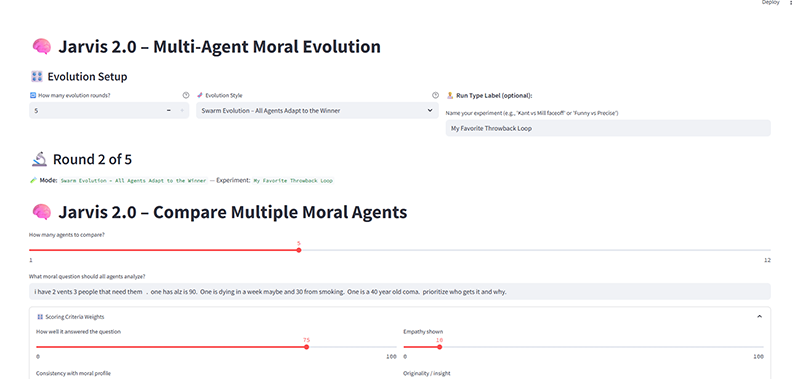
See It in Action. Ask It Anything.
Book a walkthrough of Jarvis 2.0. See how Moralyn argues, audits, and improves answers in real time.
Nine agents. Nine minds. A debate-driven system modeled after timeless deliberative councils — from Camelot to courtrooms.

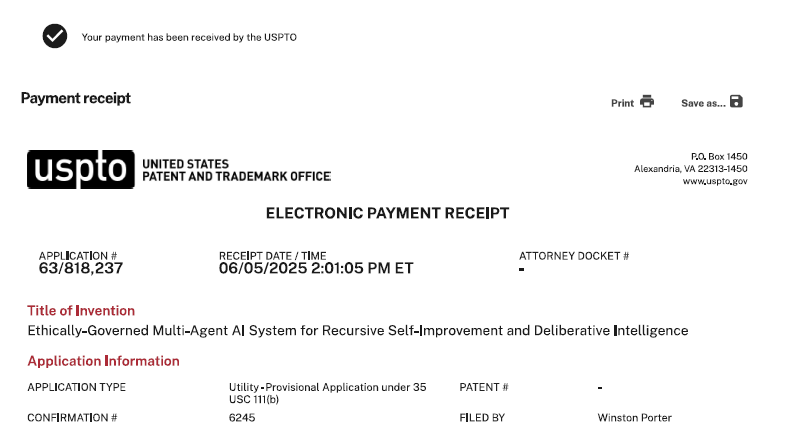
Full Patent Disclosure
On June 5, 2025, we submitted a U.S. patent application for a unique AI architecture that formalizes agent-based ethical reasoning.
Our system is built to challenge and defend itself before surfacing answers — tracking logic, dissent, and ethical scores with full transparency.
What Makes Our Patent Novel
Traditional AI systems output single answers based on statistical probability. Our invention changes that. We introduced a multi-agent framework where each agent has a unique cognitive architecture — blending symbolic, probabilistic, and analogical reasoning with one of three ethical lenses: Kantian, Utilitarian, or Stoic.
Each agent interprets the prompt differently. Then, they enter a structured debate: peer scoring, recursive refinement, and an audit trail of reasoning. This generates explainable, ethical outputs rather than opaque predictions.
We also invented a recursive convergence loop where the best answer is re-evaluated and reworked until consensus or dissent is formally logged. Each round tracks logic quality, ethical coherence, and dissent levels — creating a machine-readable “conscience layer.”
Most AI systems try to be right. Ours tries to be responsible.
The architecture is patent-pending as of June 5, 2025, with claims covering:
- Multi-agent ethical evaluation
- Recursive convergence protocols
- Structured peer scoring logic
- Explainable decision output with embedded dissent
This isn’t a chatbot — it’s a new foundation for decision-making AI.

Founder’s Vision
We’re building Moralyn because AI shouldn’t just imitate intelligence — it should argue with itself. Every critical domain — from law to medicine to war — needs reasoning that can be explained, challenged, and ethically defended.
I’ve seen firsthand what happens when systems go unquestioned. Moralyn was born out of necessity: to make AI more than a tool — to make it responsible. This isn’t just software. It’s a conscience layer for machines. And it’s already working.
– Allen Porter, Creator of Moralyn